
How to Choose Storage Unit Size for Your Needs in Cedar City
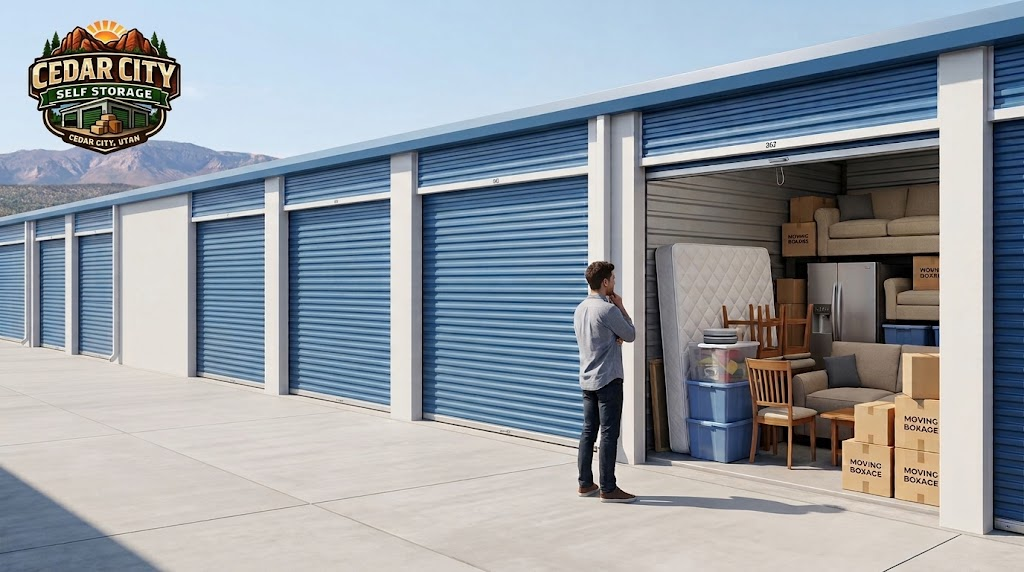
Choosing a storage unit can feel surprisingly difficult.
Choosing a storage unit can feel surprisingly difficult. The unit may look large when you see it in person, but once you start adding furniture, boxes, appliances, and other belongings, the available space can disappear quickly.That is why learning how to choose storage unit size before renting can save you both money and frustration. A unit that is too small can make your belongings difficult to organize and access. On the other hand, choosing a much larger unit than necessary means paying for space you may never use.
The best approach is to start with what you actually plan to store. Consider the size of your furniture, the number of boxes you have, how often you will need access, and whether you need extra room for a walkway. For a better understanding of the facility and its local service, learn moreabout Cedar City Self Storage.If you are comparing storage unit sizes in Cedar City, the following guide can help you understand your options and make a more practical choice.
Start With an Inventory of Your Belongings
Before looking at storage unit dimensions, make a simple inventory of the items you want to store.
You do not need to count every small object. Instead, focus on the belongings that will take up meaningful space.
Start with:
Sofas and chairs
Beds and mattresses
Dressers and nightstands
Dining tables and chairs
Refrigerators and other appliances
Desks and cabinets
Shelving
Bicycles
Tools and equipment
Seasonal decorations
Moving boxes
Business inventory
Large furniture is especially important because it cannot always be stacked or rearranged as easily as boxes.
For example, a large sectional sofa may take up more usable floor space than several dozen standard boxes. Measuring the largest pieces before choosing a unit can therefore give you a much more realistic idea of what you need.
Also think about how frequently you will use the items. If everything is going into storage while you move between homes and you will not need anything for several months, you can organize the unit differently than someone who expects to visit every week.
Storage Unit Sizes Explained
Storage units are normally described by their width and length. A 5x10 unit, for example, is approximately 5 feet wide and 10 feet long.
The amount of storage space you need depends on your belongings, but common sizes provide a useful starting point. You can comparemultiple storage unit sizes to see which option may fit your needs.
5x5 Storage Unit
A 5x5 unit provides approximately 25 square feet of floor space.
This size is similar to a large closet and can be useful when you only need to store a limited amount of belongings.
A 5x5 may work well for:
Seasonal decorations
Clothing
Several boxes
Dorm-room belongings
Small household items
Sports equipment
If your goal is simply to clear out a closet, bedroom corner, or small amount of garage space, you may not need anything larger.
5x10 Storage Unit
A 5x10 unit provides about 50 square feet of floor space.
This can be a practical choice for a studio apartment, one bedroom of furniture, or a moderate number of boxes.
A 5x10 may accommodate a mattress, dresser, smaller sofa, boxes, and other household belongings. It is also a common size for students and renters who need additional storage without requiring a full room-sized unit.
10x10 Storage Unit
A 10x10 unit provides approximately 100 square feet of floor space.
This is one of the most flexible sizes for household storage. It can be suitable for a one- or two-bedroom home depending on the amount of furniture and belongings.
A 10x10 may accommodate:
Bedroom furniture
Living room furniture
Appliances
Boxes
Shelving
Household equipment
Smaller amounts of business inventory
The square shape also gives you more flexibility when arranging larger furniture.
10x15 Storage Unit
A 10x15 unit provides approximately 150 square feet of floor space.
This can be a good middle option when a 10x10 feels too crowded but a 10x20 seems unnecessary.
It may work for a larger apartment, several rooms of furniture, a family moving between homes, or a contractor storing tools and equipment.
10x20 Storage Unit
A 10x20 unit provides approximately 200 square feet of floor space.
This is a substantial storage area and can be appropriate for larger household moves, multiple bedrooms of furniture, appliances, equipment, or business inventory.
Because there is more space available, you also have more flexibility to create an organized layout rather than stacking everything as tightly as possible.
10x30 Storage Unit
A 10x30 unit provides approximately 300 square feet of floor space.
This type of unit may be appropriate for a large household, extensive business inventory, equipment, or other substantial storage needs.
Cedar City Self Storage lists unit options ranging from smaller 5x5 spaces to larger 10x30 spaces, so your choice can be based on the actual volume of belongings you need to store.
What Size Storage Unit Do I Need?
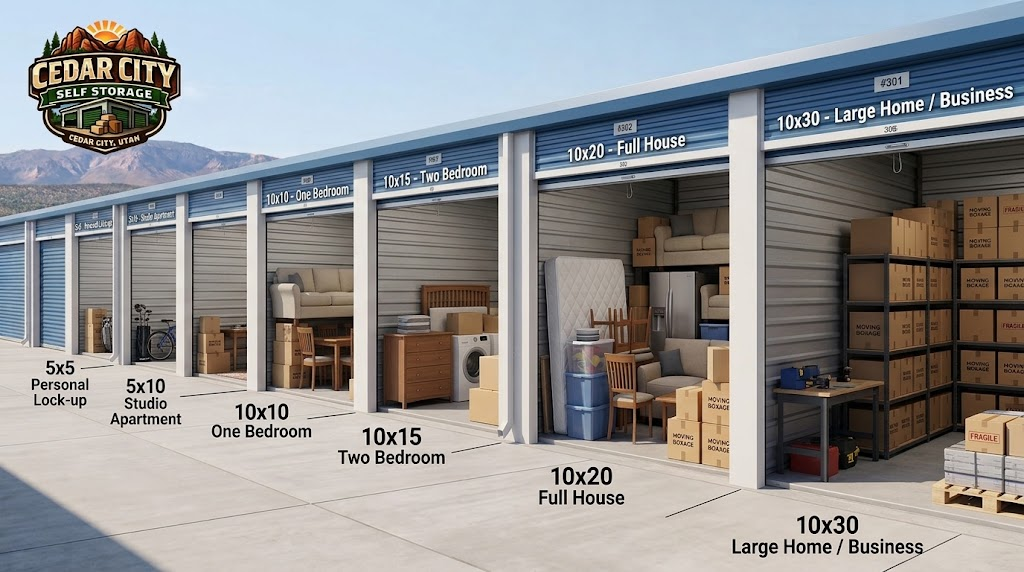
One of the most common questions people ask is, what size storage unit do I need?
One of the most common questions people ask is, what size storage unit do I need?
A simple starting point is:
A few boxes or seasonal belongings: 5x5
Studio or small apartment: 5x10
One-bedroom apartment: 5x10
Two-bedroom home: 10x10
Three-bedroom home: 10x15
Four-bedroom home: 10x20
Large home or extensive business inventory: 10x30
These are general guidelines rather than strict rules.
Two homes with the same number of bedrooms can require very different amounts of storage. One household may have minimal furniture, while another may have a garage full of tools, outdoor equipment, appliances, and boxes.
That is why the best storage unit size guide starts with your actual storage needsinstead of relying entirely on the number of rooms in your home.
Think About How Often You Will Access the Unit
Storage is not just about fitting everything inside. You also need to think about how you will use the space after it is packed.
If you are storing furniture during a move and will not need access for several months, you may be comfortable using most of the available space.
But if you are storing seasonal items, business inventory, tools, or household belongings you may need throughout the year, accessibility becomes much more important.
For example, imagine that you store Christmas decorations, winter clothing, camping equipment, and several boxes of household items.
If the Christmas decorations are placed behind a sofa, several heavy boxes, and a mattress, retrieving them later could become a frustrating job.
A little planning can make a major difference. Place frequently used belongings closer to the entrance and less frequently accessed items toward the back.
Leave Some Room to Move
One common mistake is treating a storage unit like a puzzle where every available inch must be filled.
While efficient packing is useful, completely filling a unit can make it difficult to reach anything.
If you know you will need regular access, consider leaving a narrow walkway through the unit. You may also want to leave space near the entrance for items you expect to retrieve more often.
This is particularly useful when storing business inventory or equipment.
For heavy furniture, boxes, and moving loads,drive-up storage units can also make loading and unloading more convenient because you can bring your vehicle directly to the unit door.
The storage unit itself may be the right size, but the way you organize it will determine how useful that space actually becomes.
Use Vertical Space Carefully
When people ask how to choose storage unit size, they often focus only on floor space.
Height matters too.
Boxes can often be stacked vertically when they are packed properly and remain stable. Shelving can also help keep smaller items organized without spreading them across the floor.
However, vertical storage should be approached carefully.
Heavy boxes should remain stable and easy to handle. Fragile items need appropriate protection. Items you access frequently should not be placed somewhere that requires you to move several other boxes first.
The goal is to use the available height without making the unit difficult to manage.
Small vs. Large Storage Unit
Choosing between a small and large storage unit is not simply a matter of selecting the lowest monthly price.
A smaller unit can make sense when you are storing seasonal belongings, boxes, clothing, or a limited amount of furniture.
A larger unit may be more practical when you are storing an entire household or several large pieces of furniture. For people who need flexible options for different belongings,storage units for personal and business use can provide a practical solution.
Consider a simple example.
You have a sofa, mattress, bed frame, dresser, dining table, appliances, and 25 boxes. You might be able to fit everything into a smaller unit if you pack everything very tightly.
But what happens when you need one box from the back?
You may have to move several other items first.
A slightly larger unit could give you enough room to create an access path, making the space much easier to use.
The goal is not to rent the largest unit available. It is to choose a size that balances capacity, organization, and accessibility.
Should You Use a Storage Unit Size Calculator?
A storage unit size calculator can be useful when you are unsure where to begin.
These calculators typically estimate your needs based on the number of rooms, furniture, appliances, boxes, and other belongings.
The result should be treated as a starting point rather than an exact measurement.
For example, a calculator may assume that your sofa is a standard size. If you have an oversized sectional or a large dining table, your actual storage requirements may be different.
If you are deciding between two sizes, measure the largest items and compare them with the available unit dimensions. You can alsocompare available storage options to get a better idea of which solution may fit your belongings.
Consider the Type of Storage You Need
Unit size is only one part of the decision.
The type of storage can also matter depending on what you are putting away.
For example, someone storing furniture, boxes, and heavy household items may prioritize easy loading and unloading. Someone storing temperature-sensitive belongings may have different requirements.
If you are storing business inventory, tools, or equipment, you may also want convenient access to the unit.
Cedar City Self Storage offers storage for personal belongings as well as business inventory and equipment. Its personal and business storage options are available in different sizes depending on your needs. Think about both how much space you need and how you will use that space.
Don't Forget About RV, Boat, or Vehicle Storage

If you are storing an RV, boat, trailer, or vehicle.
If you are storing an RV, boat, trailer, or vehicle, household storage calculations may not apply.Instead of measuring your needs in terms of boxes and furniture, consider the length, width, height, and maneuvering requirements of the vehicle. For dedicated vehicle storage in Cedar City, those dimensions and access requirements are especially important.For example, Cedar City Self Storage provides dedicated RV storage in Cedar City with outdoor parking for different types of motorhomes, campers, and trailers.
If you have a boat, dedicated boatand trailer storage may be more appropriate than trying to fit the watercraft into a standard household storage unit.Vehicle storage should be evaluated separately because the physical dimensions of the vehicle and the available parking configuration matter more than the square footage guidelines used for household belongings.
Common Storage Unit Size Mistakes
Choosing Based Only on Bedroom Count
The number of bedrooms is a useful starting point, but it does not tell you how much furniture, equipment, or inventory you own.
Forgetting About Large Furniture
Boxes are easy to stack. Furniture is not always easy to rearrange. Measure sofas, beds, tables, cabinets, and appliances before choosing your unit.
Filling Every Available Space
A completely full unit may look efficient, but it can become difficult to access. Leave the practical room where necessary.
Putting Frequently Used Items in the Back
Think about what you may need later. Seasonal items and frequently accessed belongings should be easier to reach.
Ignoring the Unit's Layout
Two units with similar floor dimensions may feel different depending on the door configuration, access, and available height. Check the actual unit before making your decision.
A Simple Storage Unit Size Guide
If you are still unsure which size makes sense, follow these five steps.
1. Make an Inventory
List your furniture, appliances, boxes, equipment, and other belongings.
2. Measure the Largest Items
Focus on sofas, mattresses, dining tables, appliances, cabinets, and other bulky pieces.
3. Estimate Your Storage Range
Compare your belongings with common sizes such as 5x5, 5x10, 10x10, 10x15, 10x20, and 10x30.
4. Think About Access
If you expect to visit frequently, make sure you have enough space to reach your belongings without unpacking the entire unit.
5. Compare Actual Unit Options
Look at the available dimensions rather than assuming that a unit size will automatically fit everything you own.
This process gives you a much more realistic estimate and reduces the chance of choosing a unit that is either too small or unnecessarily large.
Storage Needs Can Be Different in Cedar City
People use storage for many different reasons in Cedar City.
A Southern Utah University student may need a smaller unit for dorm furniture and personal belongings during a school break. A family moving between homes may need enough space for furniture from several rooms. A contractor may need room for tools and equipment. A local business may need additional space for inventory.
That means there is no single storage size that is right for everyone.
If you need storage for a business, the type and frequency of access may be just as important as the amount of inventory. If you are storing household belongings temporarily, your priorities may be different.
The best choice starts with understanding your own situation.
Conclusion
Learning how to choose storage unit size is mostly about understanding your belongings and how you plan to use the space.
Small units can work well for seasonal items, boxes, clothing, and limited furniture. Medium sizes provide more flexibility for apartments and several rooms of household belongings. Larger units are better suited to major moves, large households, business inventory, and substantial equipment.
Do not choose a unit based only on price or bedroom count.
Make an inventory. Measure your largest belongings. Think about how often you will need access. Then compare your requirements with the actual unit dimensions available.
If you are still deciding between two sizes, reviewing thestorage unit size options in Cedar City can help you compare the available spaces before making a decision. If you still have questions about which unit is right for your belongings, contact usand our team can help you compare your options.
The right storage unit is not necessarily the biggest one. It is the one that gives you enough room to store your belongings while keeping the space practical, organized, and accessible.
Frequently Asked Questions
What size storage unit do I need for a one-bedroom apartment?
A 5x10 unit can be a reasonable starting point for a one-bedroom apartment, depending on the amount and size of your furniture. A larger unit may be appropriate if you have oversized furniture, appliances, or many boxes.
Is a 10x10 storage unit big enough for a two-bedroom home?
A 10x10 unit can work for many two-bedroom homes, but the actual requirement depends on the amount of furniture, appliances, boxes, and other belongings you have.
Should I choose a larger storage unit just in case?
Not necessarily. Some extra room can make organization easier, but choosing a significantly larger unit means paying for space you may not use. Compare your actual inventory with the available dimensions first.
How can I estimate storage space without a calculator?
Start by making an inventory of your major belongings. Measure large furniture and appliances, estimate the number of boxes, and compare your list with common unit dimensions. A storage unit size calculator can then be used as another reference.
Can I store an RV or boat?
Yes, but RVs and boats generally require dedicated vehicle or outdoor storage rather than the same calculations used for household belongings. Check the availableRV storage options in Cedar City or boat-storage options based on the size of your vehicle or trailer.